




Starlink vs Fibre Internet Kenya
Compare Starlink vs Fibre Internet Kenya for prices, speed, latency, reliability, installation, rural coverage, business use and backup internet.
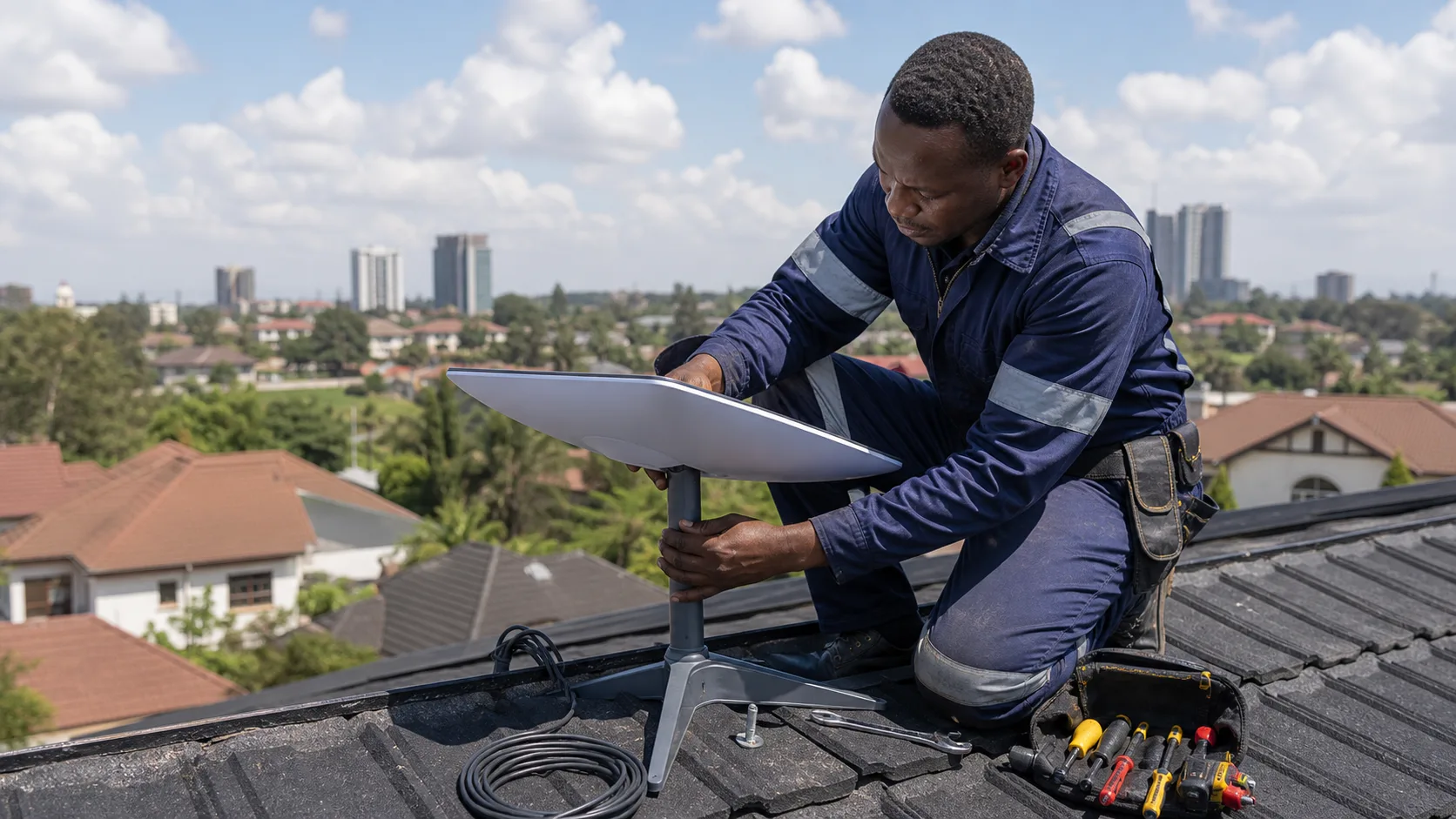
Starlink vs Fibre Internet Kenya: Prices, Speed, Reliability & Key Differences
If you are comparing Starlink vs Fibre Internet Kenya, the right choice depends heavily on where you live, how you use the internet, the availability of fibre at your location and whether you need a fixed or more flexible connectivity solution.
Fibre internet has become a common choice for homes and businesses in towns and cities across Kenya. It can provide high-speed connectivity at competitive monthly prices where fibre infrastructure is available. Starlink takes a different approach by connecting customers through satellites rather than a physical fibre line running to the property.
This difference becomes especially important outside areas with extensive fibre coverage. A customer in Nairobi, Ruiru, Mombasa or another urban area may have several fibre providers to choose from, while a farm, lodge, rural home, construction site or remote office may have far fewer wired options.
The comparison should therefore go beyond advertised download speeds. Installation costs, monthly charges, availability, latency, portability, power requirements, network design and the type of property all matter when comparing Starlink vs Fibre Internet Kenya.
Table of Contents
-
Starlink vs Fibre Internet Kenya at a Glance
-
What Is Starlink Internet?
-
What Is Fibre Internet?
-
Starlink vs Fibre Prices in Kenya
-
Starlink vs Fibre Speed
-
Starlink vs Fibre Latency
-
Reliability Comparison
-
Availability Across Kenya
-
Installation Comparison
-
Portability and Mobility
-
Starlink vs Fibre for Homes
-
Starlink vs Fibre for Businesses
-
Starlink vs Fibre for Rural Areas
-
Starlink as Fibre Backup
-
Power Requirements
-
Wi-Fi Coverage
-
Which Applications Work With Each?
-
Cost Factors to Consider
-
Where to Buy Starlink in Kenya
-
Frequently Asked Questions
-
Final Comparison
Starlink vs Fibre Internet Kenya at a Glance
Starlink and fibre use completely different technologies.
| Feature | Starlink | Fibre Internet |
|---|---|---|
| Connection type | Satellite | Fibre-optic cable |
| Requires local fibre infrastructure | No | Yes |
| Suitable for remote locations | Yes, where service is available | Depends on coverage |
| Latency | Generally higher than fibre | Generally lower |
| Installation | Dish and suitable sky view | Fibre cable installation |
| Portability | Available on applicable plans | Generally fixed |
| Weather considerations | Can be affected in some conditions | Not affected by satellite signal/weather in the same way |
| Monthly price | Depends on Starlink plan | Depends on ISP and package |
| Hardware | Starlink terminal and router | Fibre ONT/router |
| Backup use | Possible | Possible |
Neither technology is automatically suitable for every property.
The location and intended use should be the starting point.
What Is Starlink Internet?
Starlink is a satellite internet service operated through a network of satellites in low Earth orbit.
Instead of requiring a fibre cable to reach your property, Starlink uses an outdoor terminal to communicate with satellites.
The basic connection is:
Starlink satellite
↓
Starlink terminal
↓
Router
↓
Your devices
This makes Starlink useful in locations where fibre infrastructure has not reached.
Starlink's official Kenya service page currently lists Residential Lite at KES 4,000 per month and Residential at KES 6,500 per month. (starlink.com)
The hardware is purchased separately.
What Is Fibre Internet?
Fibre internet uses fibre-optic cables to transmit data between your premises and the ISP's network.
A typical installation works approximately like this:
ISP network
↓
Fibre cable
↓
ONT/router
↓
Your network
Fibre networks can deliver high speeds with relatively low latency.
The major limitation is availability.
A fibre provider must have infrastructure serving your location, or be willing to extend the network to your property.
This is easy in some urban areas but can be difficult or unavailable in remote locations.
Starlink vs Fibre Prices in Kenya
Price is one of the biggest reasons people search for Starlink Prices in Kenya.
However, comparing Starlink and fibre prices requires separating:
-
Hardware
-
Installation
-
Monthly subscription
-
Networking equipment
Starlink costs
For Starlink, customers normally need to consider:
Starlink hardware
Installation if required
Mounting if required
Monthly subscription
Starlink's current Kenya service page lists:
| Starlink plan | Current monthly price |
|---|---|
| Residential Lite | KES 4,000 |
| Residential | KES 6,500 |
| Roam 50GB | KES 6,500 |
Hardware prices are separate and can vary by seller and hardware model.
For a detailed hardware comparison, see the Starlink Kit Price in Kenya article on Tawa.
Fibre costs
Fibre providers in Kenya offer different plans and prices.
The price can depend on:
-
ISP
-
Speed
-
Location
-
Promotional offers
-
Installation terms
-
Data policy
-
Router arrangement
Therefore, there is no single fibre price for the whole country.
A customer should compare the actual plans available at their address.
Starlink vs Fibre Speed
Speed is an important consideration, but the advertised maximum speed is not the only factor.
Starlink performance can vary depending on:
-
Network congestion
-
Service plan
-
Location
-
Obstructions
-
Network conditions
-
Hardware
Fibre performance can also vary depending on:
-
ISP network
-
Package
-
Local congestion
-
Wi-Fi setup
-
Router
-
Internal network
A wired fibre connection can generally provide lower latency and consistent performance where the network is properly deployed.
Starlink can provide useful high-speed connectivity without requiring a physical fibre connection to the property.
The best comparison is therefore the actual service available at your address rather than theoretical maximum speeds.
Starlink vs Fibre Latency
Latency is the time it takes data to travel between your device and a destination.
This matters for:
-
Video calls
-
Online gaming
-
Remote desktops
-
VoIP
-
Financial applications
-
Interactive cloud applications
Fibre generally has lower latency because data travels through terrestrial fibre infrastructure.
Starlink uses satellites in low Earth orbit, which introduces additional distance into the connection.
This does not mean Starlink is unusable for interactive applications.
It means customers should expect latency characteristics to differ from fibre.
For ordinary:
-
Browsing
-
Streaming
-
Email
-
Social media
-
Cloud applications
-
Video meetings
the connection can still be useful.
For applications where extremely low latency is critical, fibre can have an important technical advantage.
Starlink vs Fibre Reliability
Reliability depends on more than the technology.
Fibre can be affected by:
-
Fibre cuts
-
Construction
-
Power outages at network infrastructure
-
ISP outages
-
Equipment failures
-
Last-mile problems
Starlink can be affected by:
-
Obstructions
-
Heavy environmental conditions
-
Hardware issues
-
Power outages
-
Network congestion
-
Satellite service conditions
Starlink requires a suitable view of the sky.
Starlink's installation guidance specifically recommends selecting a location with as few obstructions as possible. (starlink.com)
For both technologies, local conditions matter.
Starlink vs Fibre Availability Across Kenya
This is one of the biggest differences.
Fibre availability depends on whether a fibre provider has infrastructure in your neighbourhood or building.
Starlink does not require the same local last-mile fibre infrastructure.
That makes it particularly relevant for:
-
Rural homes
-
Farms
-
Ranches
-
Lodges
-
Remote offices
-
Construction sites
-
Field projects
However, Starlink still requires service availability and a suitable installation environment.
For customers in cities where several fibre providers are available, fibre may be one of several choices.
For customers outside fibre coverage, Starlink can provide another option.
Starlink vs Fibre Installation
Starlink installation
A typical Starlink setup requires:
-
Starlink terminal
-
Suitable location
-
Power
-
Cable
-
Router
Professional installation may additionally involve:
-
Roof mount
-
Wall mount
-
Pole
-
Cable routing
-
Network configuration
Starlink is designed to support customer installation, although professional installation can be useful for complex sites.
See the detailed Starlink Installation Cost in Kenya guide for more information.
Fibre installation
Fibre installation normally involves:
-
Fibre availability check
-
Connection from the provider's network
-
Fibre cable to the premises
-
ONT/router installation
-
Connection testing
The exact installation process depends on the ISP and property.
Starlink vs Fibre Portability
Starlink has an important advantage for customers who need connectivity at locations where wired internet is unavailable.
The Starlink Mini, for example, is a compact terminal with integrated Wi-Fi.
Starlink's official Mini specifications list dimensions of approximately:
298.5 × 259 × 38.5 mm
and a terminal weight of approximately:
1.10 kg. (starlink.com)
Starlink also offers Roam service plans for supported use cases.
The current Kenya service page lists a Roam 50GB plan at KES 6,500/month. (starlink.com)
Fibre, by contrast, is generally tied to the physical location where the fibre cable terminates.
Starlink vs Fibre for Homes in Kenya
For a home in an urban area with reliable fibre coverage, the comparison can focus on:
-
Monthly price
-
Speed
-
Latency
-
Reliability
-
Data policy
-
Installation
-
Wi-Fi coverage
For a rural home without fibre, availability becomes much more important.
A typical Starlink home setup can be:
Starlink
→ Router
→ Wi-Fi devices
A larger home may require additional access points.
The Starlink connection provides the internet, but the internal Wi-Fi network determines how effectively that connection reaches different rooms.
Starlink vs Fibre for Businesses
Businesses should consider more than speed.
Important factors include:
-
Uptime
-
Latency
-
Public IP requirements
-
Static IP requirements
-
Support
-
Failover
-
Network management
-
User count
-
Data usage
A business located in an area with reliable fibre may use fibre as its primary connection.
A business in a remote area may use Starlink as its primary connection.
Another option is to use both.
Starlink vs Fibre for Rural Kenya
This is one situation where Starlink can be particularly relevant.
A rural property may have:
-
No fibre
-
Limited mobile coverage
-
Long distances to the nearest town
-
Difficult installation conditions
Starlink can provide connectivity without requiring a fibre cable to be extended to the property.
Potential rural applications include:
-
Farms
-
Schools
-
Lodges
-
Clinics
-
Rural businesses
-
Construction sites
-
Research stations
The property still requires power and a suitable location for the Starlink terminal.
Starlink as Fibre Backup Internet
Businesses do not necessarily have to choose one technology.
A business can combine:
Fibre + Starlink
using a dual-WAN router or firewall.
For example:
Fibre
→ Primary WAN
Starlink
→ Secondary WAN
The router can automatically move traffic to Starlink when the fibre connection fails.
This approach can be useful for businesses that depend heavily on internet connectivity.
Possible applications include:
-
POS systems
-
Cloud software
-
CCTV
-
VoIP
-
Online stores
-
Customer Wi-Fi
-
Remote access
MikroTik routers and other business firewalls can be configured for multi-WAN and failover depending on the model and network design.
Starlink vs Fibre Power Requirements
Both technologies require electricity at the customer's premises.
Starlink
The terminal and networking equipment require power.
Starlink's Mini has an average power consumption of approximately 25–40 W, according to the official specification sheet. (starlink.com)
Fibre
The ONT/router also requires electricity.
For both systems, a UPS can help maintain connectivity during short power interruptions.
Businesses with unreliable electricity may consider:
-
UPS
-
Inverter
-
Battery
-
Solar
-
Generator
The power requirements should be calculated for the complete network, not just the internet terminal.
Starlink vs Fibre Wi-Fi Coverage
The internet connection is only one part of the customer experience.
A large building may have poor Wi-Fi even when the internet connection itself is fast.
For example:
Internet connection
↓
Router
↓
Access points
↓
Users
This applies to both Starlink and fibre.
A three-storey office may require several access points.
A hotel may require dozens.
A farm may need outdoor Wi-Fi.
The internal network should therefore be designed independently of whether the upstream connection is Starlink or fibre.
Starlink vs Fibre for Video Streaming
Both technologies can support streaming when the connection is performing properly.
Streaming applications include:
-
YouTube
-
Netflix
-
Live broadcasts
-
Cloud video
-
Social media video
The actual experience depends on:
-
Available bandwidth
-
Congestion
-
Wi-Fi quality
-
Number of simultaneous users
A household with many simultaneous high-bandwidth users should consider the complete network rather than looking only at the internet provider's advertised speed.
Starlink vs Fibre for Video Conferencing
Video conferencing depends on both bandwidth and latency.
Applications include:
-
Zoom
-
Microsoft Teams
-
Google Meet
-
WhatsApp calls
-
VoIP
Fibre's lower latency can make it technically attractive for interactive applications.
Starlink can also support video conferencing where the connection is stable and properly installed.
For remote businesses without fibre, Starlink can therefore provide an important connectivity option.
Starlink vs Fibre for Online Gaming
Online gaming is particularly sensitive to latency and connection stability.
Fibre generally has an advantage in latency.
Starlink can still support gaming, but the experience can vary depending on network conditions and the game being played.
Competitive gamers who have access to reliable low-latency fibre may consider latency an important factor in their decision.
Starlink vs Fibre for CCTV
Both Starlink and fibre can be used for CCTV systems.
However, CCTV can consume significant bandwidth when cameras are continuously uploading video to cloud platforms.
For a business with several cameras, consider:
-
Camera resolution
-
Recording method
-
Upload bandwidth
-
Storage
-
Remote viewing
-
Number of cameras
A local NVR can reduce the amount of continuous video that needs to travel over the internet.
Starlink vs Fibre for Remote Access and VPN
Businesses using VPNs should consider:
-
Latency
-
Upload performance
-
IP addressing
-
Firewall configuration
-
Stability
Starlink Priority plans can provide public IP functionality in supported markets, according to Starlink's business information. (starlink.com)
However, businesses should confirm the current configuration available on their specific plan before designing a VPN or remote-access service around it.
Total Cost of Starlink vs Fibre
A useful way to compare the two is to calculate the total cost of ownership.
Starlink
Hardware
Installation
Mounting
Monthly service
Power backup
Networking
Fibre
Installation
Router/ONT
Monthly service
Power backup
Networking
The actual figures vary significantly by ISP, location, hardware and property.
This means the cheapest monthly plan is not necessarily the cheapest complete connectivity solution.
Where to Buy Starlink Equipment in Kenya
If Starlink is the more suitable option for your location, research the hardware and service carefully.
You can explore:
Orbitlink Solutions Starlink Kenya Prices
When purchasing hardware, verify the model, condition, package contents, warranty and current price.
How Tawa Supports Starlink and Fibre Networks
Tawa.co.ke can supply networking equipment needed after your internet connection reaches the premises.
Depending on the installation, this can include:
-
Network switches
-
Managed switches
-
PoE switches
-
Wireless access points
-
Routers
-
Ethernet cables
-
Fibre networking equipment
-
Power accessories
This applies whether the upstream connection is Starlink or fibre.
For example:
Starlink or Fibre
↓
Router
↓
Switch
↓
Access Points
↓
Users
The correct equipment depends on the size of the network and number of users.
Starlink vs Fibre: Questions to Ask Before Choosing
Before choosing your internet connection, ask:
Is fibre available at my property?
If not, Starlink may be worth considering.
What latency do my applications require?
Gaming, remote desktops and certain business applications can benefit from low latency.
How many people will use the connection?
A larger user base may require more network planning.
Do I need mobility?
If yes, Starlink may offer options that fibre does not.
Do I need a public IP?
If yes, check the exact capabilities of the selected service plan.
Is the location remote?
Remote locations can make Starlink particularly relevant.
Do I need backup internet?
If internet downtime is expensive, consider using both technologies.
Frequently Asked Questions
Is Starlink better than fibre in Kenya?
Starlink and fibre have different strengths. Fibre generally offers lower latency and can provide high-speed connectivity where the infrastructure is available. Starlink can provide connectivity in locations where fibre infrastructure is unavailable. The appropriate option depends on the location and intended use.
Is Starlink cheaper than fibre in Kenya?
The answer depends on the complete cost. Starlink requires hardware in addition to the monthly service, while fibre pricing varies by ISP and package. Starlink's current Kenya Residential plans are KES 4,000 and KES 6,500 per month, excluding the initial hardware purchase. (starlink.com)
Which has lower latency, Starlink or fibre?
Fibre generally has lower latency because data travels through terrestrial fibre infrastructure. Starlink uses low-Earth-orbit satellites, adding satellite communication distance to the connection.
Can Starlink replace fibre internet?
For some homes and businesses, yes. It can provide the primary internet connection where Starlink is available and properly installed. However, customers with reliable fibre should compare both technologies based on their specific requirements.
Can I use Starlink and fibre together?
Yes. A compatible router or firewall can use fibre as one WAN connection and Starlink as another, allowing the network to implement failover or other multi-WAN configurations.
Is Starlink good for rural areas in Kenya?
Starlink can be useful for rural properties where conventional broadband infrastructure is limited or unavailable, provided the service is available and the terminal has a suitable view of the sky.
Does Starlink require fibre?
No. Starlink connects the customer through satellites rather than requiring a fibre cable to reach the property.
Does fibre work without electricity?
The equipment inside the property normally requires electricity. A UPS or other backup-power system can keep the local equipment operating during some power interruptions, but the ISP's network infrastructure also needs to remain operational.
Can Starlink be used for business?
Yes. Starlink provides business-oriented service options in supported markets. Priority plans can include features such as network priority and public IP functionality. Businesses should confirm the current plan available for their location. (starlink.com)
Which is better for gaming, Starlink or fibre?
Fibre generally has a latency advantage, which can matter for latency-sensitive gaming. Starlink can still support online gaming, but the experience depends on the service, network conditions and game.
Final Comparison: Starlink vs Fibre Internet Kenya
The Starlink vs Fibre Internet Kenya comparison comes down to the circumstances of the customer.
Fibre is a wired technology that can offer low latency and high-speed connectivity where the infrastructure is available.
Starlink is a satellite-based technology that can provide connectivity without requiring a fibre cable to reach the customer's property.
For an urban home with reliable fibre coverage, customers can compare monthly cost, speed, latency, reliability and service terms.
For a rural home, farm, lodge or remote business without fibre, Starlink can provide an alternative path to internet connectivity.
Businesses can also use both technologies together.
Fibre + Starlink
can provide network redundancy when configured with an appropriate router or firewall.
The most important thing is to compare the complete solution rather than one headline number.
Consider:
Monthly service + hardware + installation + networking + power + reliability + availability
For customers researching the wider Starlink Prices in Kenya, the hardware and subscription costs should be evaluated together with installation and network requirements.
Tawa.co.ke can provide networking hardware that complements either Starlink or fibre, including switches, access points, routers, cables and other networking equipment.